We use cookies to ensure that we give you the best experience possible while on our website.
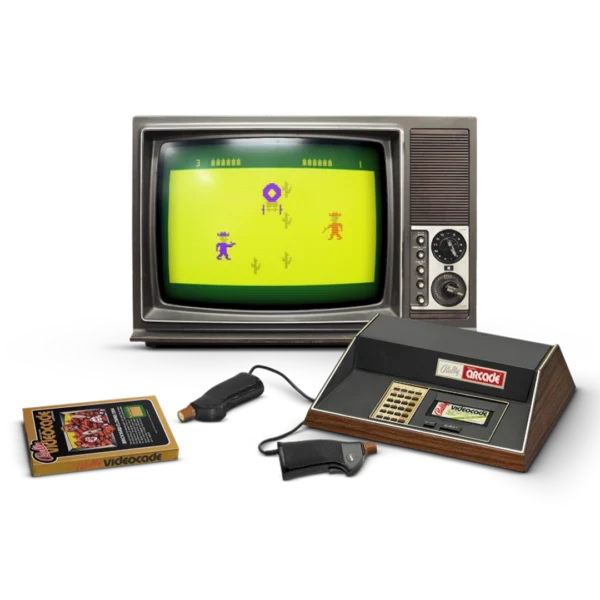
The Bally Astrocade (also known as Bally Arcade and initially as Bally ABA-1000) is a second-generation home video game console and simple computer system designed by a team at Midway, at that time the video game division of Bally.
It was originally announced as the “Bally Home Library Computer” in October 1977 and made available for mail order in December 1977. Due to production delays, the units were first released to stores in April 1978 and its branding changed to “Bally Professional Arcade”. It was marketed only for a limited time before Bally decided to exit the market. The rights were later picked up by a third-party company, who re-released it and sold it until around 1984.
The Astrocade is particularly notable for its very powerful graphics capabilities for the time of release, and for the difficulty in accessing those capabilities.
Nutting and Midway
In the late 1970s, Midway contracted Dave Nutting Associates to design a video display chip that could be used in all of their videogame systems, from standup arcade games, to a home computer system. The system Nutting delivered was used in most of Midway’s classic arcade games of the era, including Gorf and Wizard of Wor. The chipset supported what was at that time relatively high resolution of 320×204 in four colors per line, although to access this mode required memory that could be accessed at a faster rate than the common 2 MHz dynamic RAM of the era.