We use cookies to ensure that we give you the best experience possible while on our website.
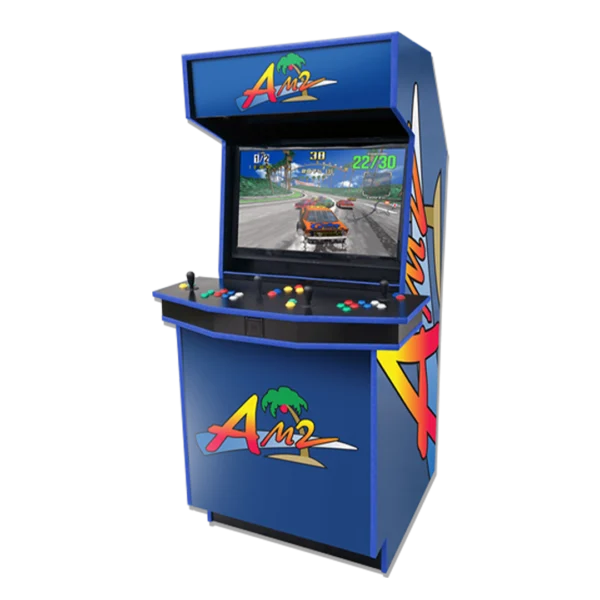
Sega Model 2 was an arcade system board developed by Sega AM2 in 1993 as a direct evolution of the earlier Model 1. The board was state-of-the-art for its time, costing $2,000,000 to develop. The system would power arcade hits of the mid-1990s such as Daytona USA, Virtua Fighter 2 and The House of The Dead.
History
Designed by Yu Suzuki of Sega AM2 and co-developed by Sega and GE Aerospace (now a part of Lockheed Martin), the Model 2 was an advancement of the earlier Model 1, which ran the arcade hit, Virtua Fighter. It featured texture-mapping, which allowed for polygons to be painted with bitmap images, in addition to innovative texture filtering, texture anti-aliasing and trilinear filtering features. This made it the most powerful system of its time, equivalent to a late-1990s PC graphics accelerator card.
It was stated by Suzuki that the texture-mapping chip originated “from military equipment from Lockheed Martin, which was formerly General Electric Aerial & Space’s textural mapping technology. It cost $2 million dollars to use the chip. It was part of flight-simulation equipment that cost $32 million. I asked how much it would cost to buy just the chip and they came back with $2 million. And I had to take that chip and convert it for video game use, and make the technology available for the consumer at 5,000 yen ($50)” ($84 in 2014) per machine. He said “it was tough but we were able to make it for 5,000 yen. Nobody at Sega believed me when I said I wanted to purchase this technology for our games.” Suzuki had also stated that, in “the end,” it “was a hit and the industry gained mass-produced texture-mapping as a result.” For Virtua Fighter 2, he also utilized motion capture technology, introducing it to the video game industry.